
Murray Hill is the neighborhood where J.P. Morgan built his private library next to his house and walked between them in a bathrobe, where ten brick carriage houses from 1863 hide in a courtyard most New Yorkers have never noticed, and where the most powerful private land-use agreement in New York City history kept commercial development off the residential blocks for nearly a hundred years. It is not a neighborhood that announces itself. It sits between 34th and 40th Streets, from roughly Second Avenue to Fifth Avenue, in a section of Midtown Manhattan that most people walk through on their way to Grand Central without realizing they are passing through one of the most historically layered residential neighborhoods in the city.
The cleaning work here reflects that layering. A Murray Hill apartment might have original 1920s plaster walls and hardwood floors in a prewar co-op on Park Avenue, or it might be a utilitarian postwar rental on Third Avenue with laminate counters and vinyl flooring. The brownstones in the Murray Hill Historic District have surfaces from the 1850s that react to the wrong cleaning product the way old paper reacts to water. You cannot clean all of Murray Hill the same way. The approach changes building by building, and sometimes floor by floor.
But the buildings are only part of the story. Murray Hill has a history that most of its own residents, particularly the younger renters who make up the majority of the population, have never fully explored. It is a history that involves a Quaker merchant’s wife delaying the British army with tea and cake, a financier who personally bailed out the United States government, a spice shop that has been open since 1944, and a neighborhood association that functioned as a private zoning board decades before the city had one.
The Murray family delayed the British army from a farmhouse on what is now Park Avenue
The land that became Murray Hill was Lenape territory, part of the elevated terrain the Dutch called the Inclenberg, a gentle rise running from roughly 34th to 40th Streets. Robert Murray, a Quaker merchant from Pennsylvania, acquired the hill in the 1750s and built a country house near what is now 36th Street and Park Avenue. The estate was called Inclenberg, and it sat on one of the most prominent natural features of midland Manhattan.
The neighborhood’s most famous historical moment came on September 15, 1776. After British forces landed at Kip’s Bay, General Howe and his officers marched toward the Murray estate. Mary Lindley Murray, Robert’s wife, invited the British officers inside for tea, cake, and wine. According to the legend that has been retold for 250 years, she deliberately detained them for roughly two hours while General Israel Putnam led approximately 4,000 American troops up the west side of Manhattan to safety at Harlem Heights.
Historians have debated the story’s accuracy since the 1800s. Some dismiss it as embellishment. Others argue that the documented timeline supports a meaningful delay. Either way, Mary Murray became one of the most celebrated figures in New York Revolutionary lore, and a marker on Park Avenue still acknowledges the Murray estate. The neighborhood carries her family’s name because they owned the hill, but it is Mary’s story that people remember.
After the Revolution, the estate was broken up and sold. New York’s population expanded northward through the 19th century, and the Murray Hill blocks were developed as fashionable residential streets for the city’s upper and upper-middle classes. Brownstone and brick townhouses went up from the 1840s through the 1880s. By the Gilded Age, Murray Hill was one of the most exclusive addresses in New York.
J.P. Morgan’s private library holds three Gutenberg Bibles on East 36th Street
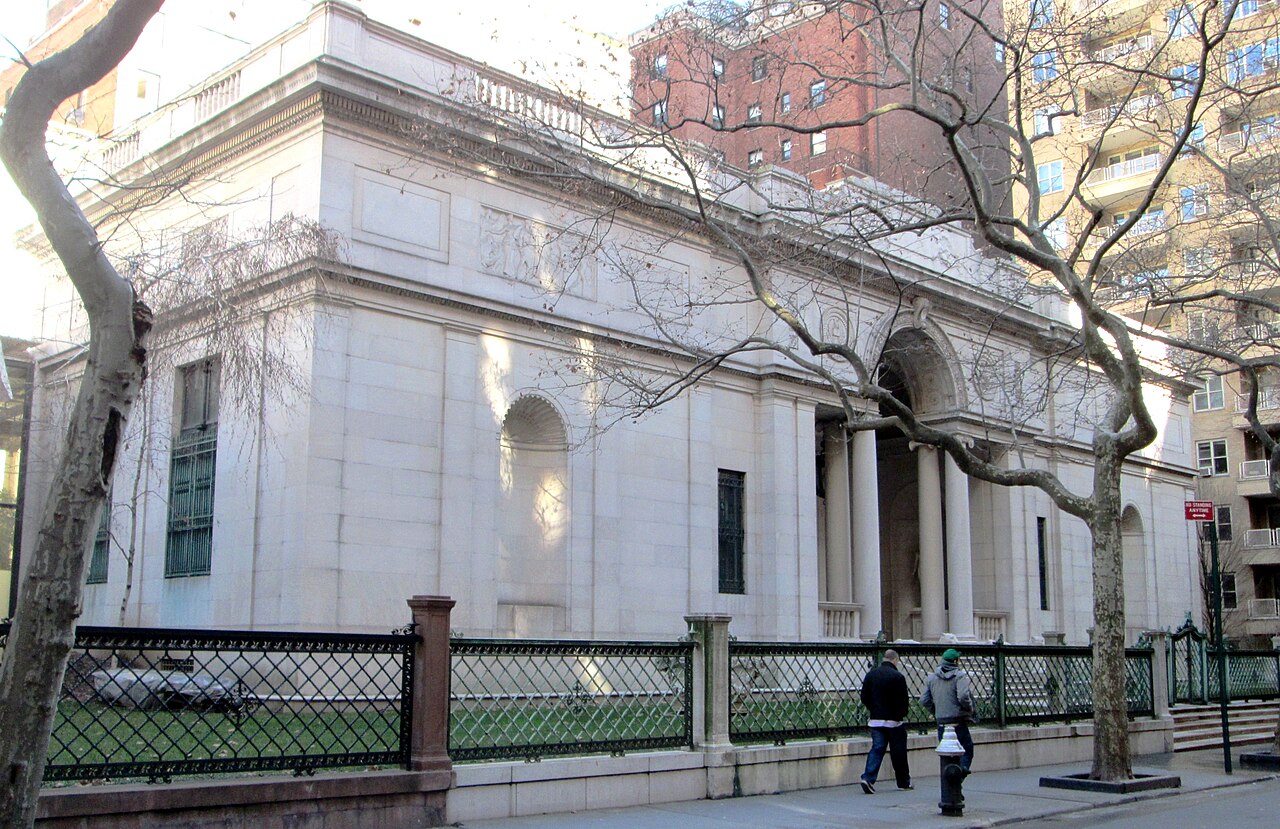
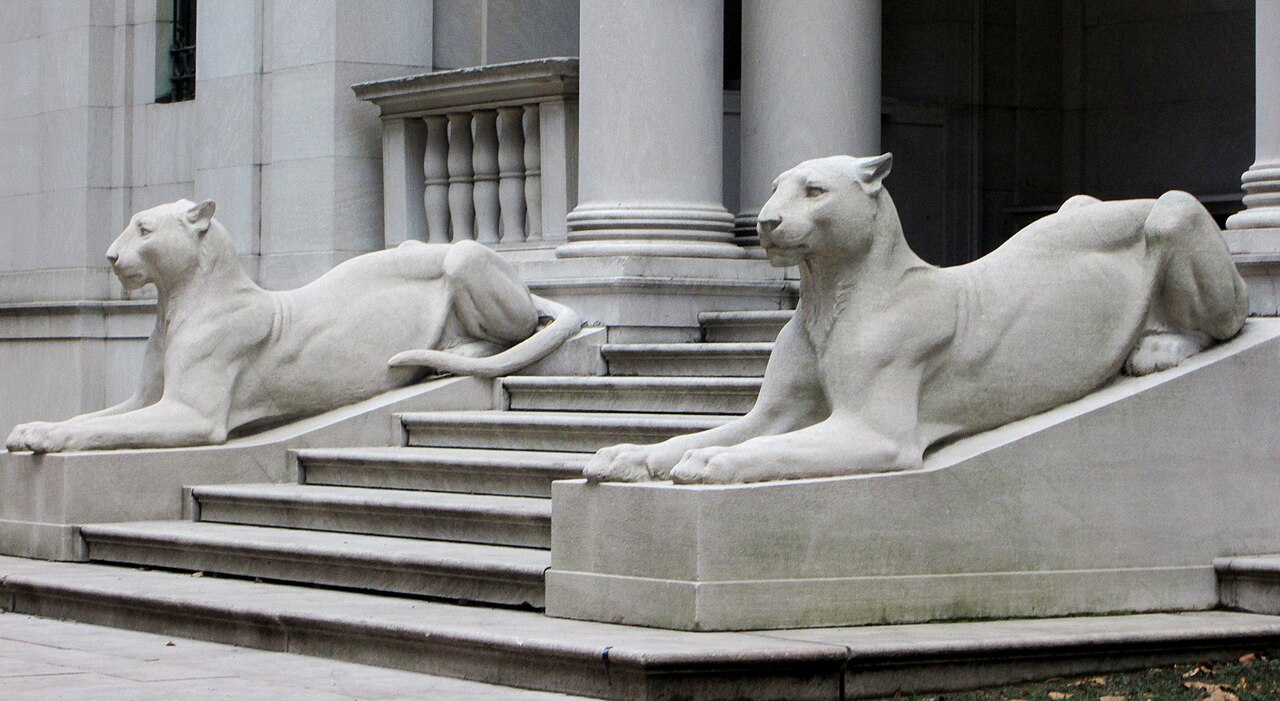
The architectural and cultural heart of Murray Hill is the Morgan Library and Museum at 225 East 36th Street. J. Pierpont Morgan, the most powerful banker and financier in American history, lived at 219 East 36th Street and built his private library next door in 1906. The building, designed by McKim, Mead and White, is a masterwork of Italian Renaissance Revival architecture. White marble, Ionic columns, and a facade that evokes a Roman palazzo sitting on a residential side street in Midtown Manhattan.
The collection inside is staggering. Three of the approximately 49 surviving Gutenberg Bibles are here, making the Morgan one of the greatest concentrations of the most important printed book in history. Original manuscripts by Dickens, Thoreau, and Walter Scott. Mozart’s handwritten musical scores. Medieval illuminated manuscripts. The East Room, Morgan’s personal library, is one of the most beautiful interior spaces in New York City. Three tiers of leather-bound books, Flemish tapestries, a painted ceiling, and the kind of concentrated grandeur that makes you speak quietly without anyone telling you to.
Morgan was famous for conducting early-morning business at the library in his dressing gown, having walked directly from his brownstone through a private garden connection. The brownstone itself was later demolished, but the library complex expanded. Renzo Piano designed a modern glass pavilion addition in 2006 that connects the original structures with light and air. The result is a campus that spans centuries of architectural ambition, all on a single block.
Sniffen Court is one of the last hidden mews left in Manhattan
At 150 to 158 East 36th Street, between Lexington and Third Avenues, there is a wrought-iron gate that opens onto a private courtyard lined with ten brick carriage houses built in 1863 and 1864. This is Sniffen Court, and it is one of the most remarkable hidden spaces in all of New York. You can walk down 36th Street and pass the entrance without noticing it. The courtyard is narrow, quiet, and almost impossibly intimate for a location three blocks from the noise of Third Avenue.
The carriage houses were built to serve the wealthy families living on the surrounding blocks. By the 20th century, they had been converted to private residences and artists’ studios. The sculptor Malvina Hoffman, who created the famous Races of Mankind series for the Field Museum in Chicago, lived and worked in one of the Sniffen Court houses. The entire mews was designated a New York City Landmark in 1966.
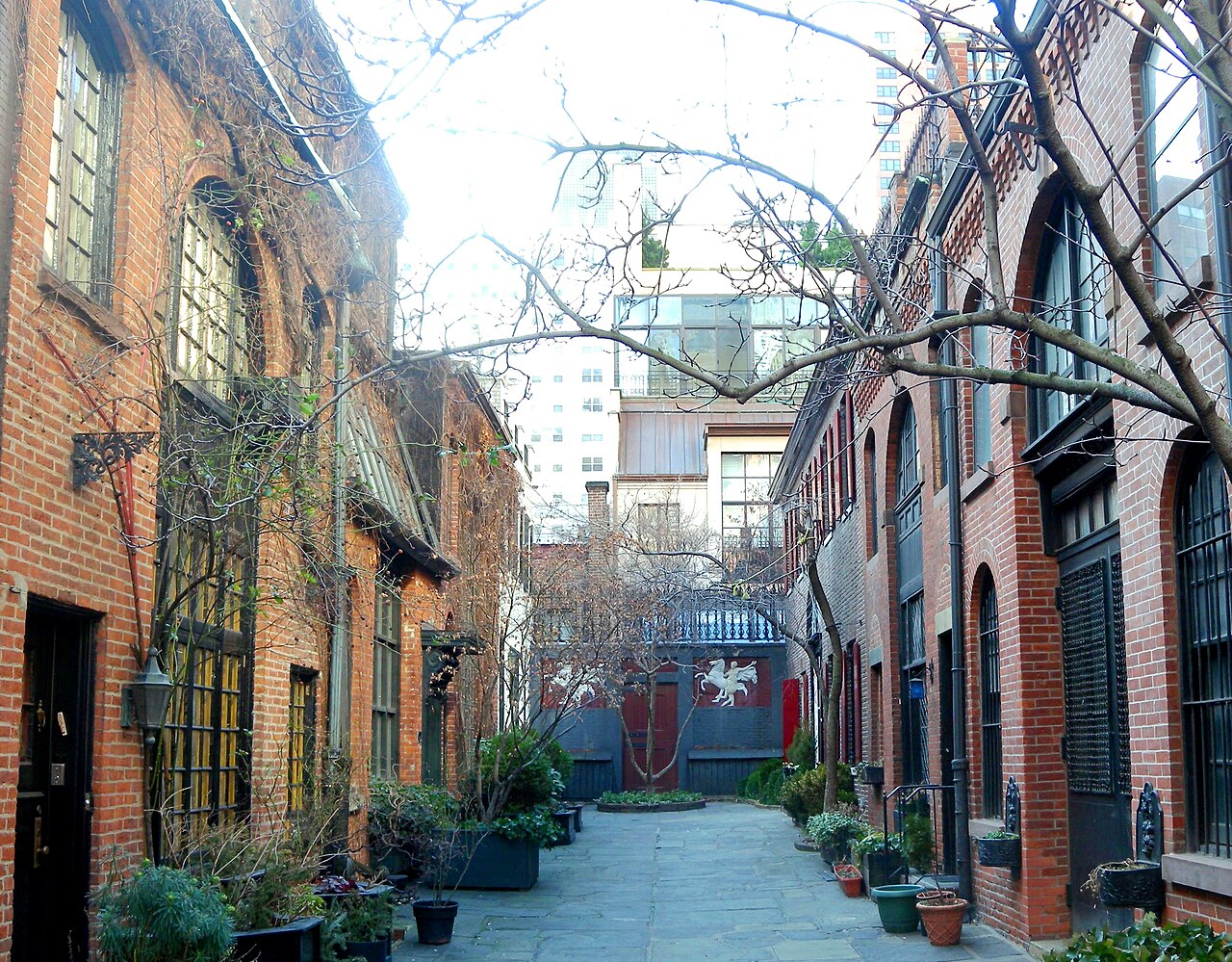
Mews like this once existed throughout Manhattan. Private alleys behind grand houses, lined with stables and servants’ quarters, tucked away from the public streets. Almost all of them were demolished as the city densified. Sniffen Court survived because the Murray Hill neighborhood’s restrictive deed covenants, imposed by the Murray Hill Association starting in 1847, protected the residential character of these blocks for nearly a century. The covenants prohibited commercial use, stables converted to factories, and various other intrusions. They functioned as a private zoning ordinance, one of the earliest and longest-lasting in New York City history, and they kept the development pressure off the side streets long enough for the carriage houses to become valuable as residences rather than expendable as real estate.
Murray Hill’s young professionals moved in when the Third Avenue El came down
The neighborhood’s identity shifted decisively in the middle of the 20th century. The elevated railway that had run above Third Avenue since the 1870s was demolished in 1955, and the corridor opened up to new construction. Prewar co-ops and postwar rental towers replaced the shadow and noise of the El. Young professionals moved in. Lawyers, advertising executives, and finance workers drawn by the short commute to Midtown offices found apartments that were more affordable than the Upper East Side and more residential than the blocks directly around Grand Central.
By the 1980s and 1990s, Murray Hill had acquired a specific cultural reputation. The Irish pubs and sports bars along Third Avenue attracted a post-college crowd, and the neighborhood became known in New York social shorthand as “Bro Hill,” a landing zone for recent graduates from the suburbs. The reputation stuck for two decades and it was never entirely wrong. The bars were real and the crowds were real.
But the reputation has softened considerably since the 2010s. Murray Hill has diversified. The South Asian community, concentrated on Lexington Avenue in the high 20s and low 30s in the area known as Curry Hill, has deepened and expanded. International residents, older professionals, and families have diluted the monoculture that the bar scene once represented. The median age is still young, around 30 to 33, and the rental population still turns over. But the neighborhood now has more layers than the stereotype ever captured.
Curry Hill runs from the southern edge into one of the best food corridors in Manhattan
The stretch of Lexington Avenue between roughly 27th and 30th Streets, technically at Murray Hill’s southern boundary and overlapping with Rose Hill, is one of the most distinctive food corridors in New York City. Dozens of Indian, Bangladeshi, and Pakistani restaurants line the block. Sweet shops display trays of barfi and gulab jamun. Grocery stores stock everything from dried lentils to fresh curry leaves.
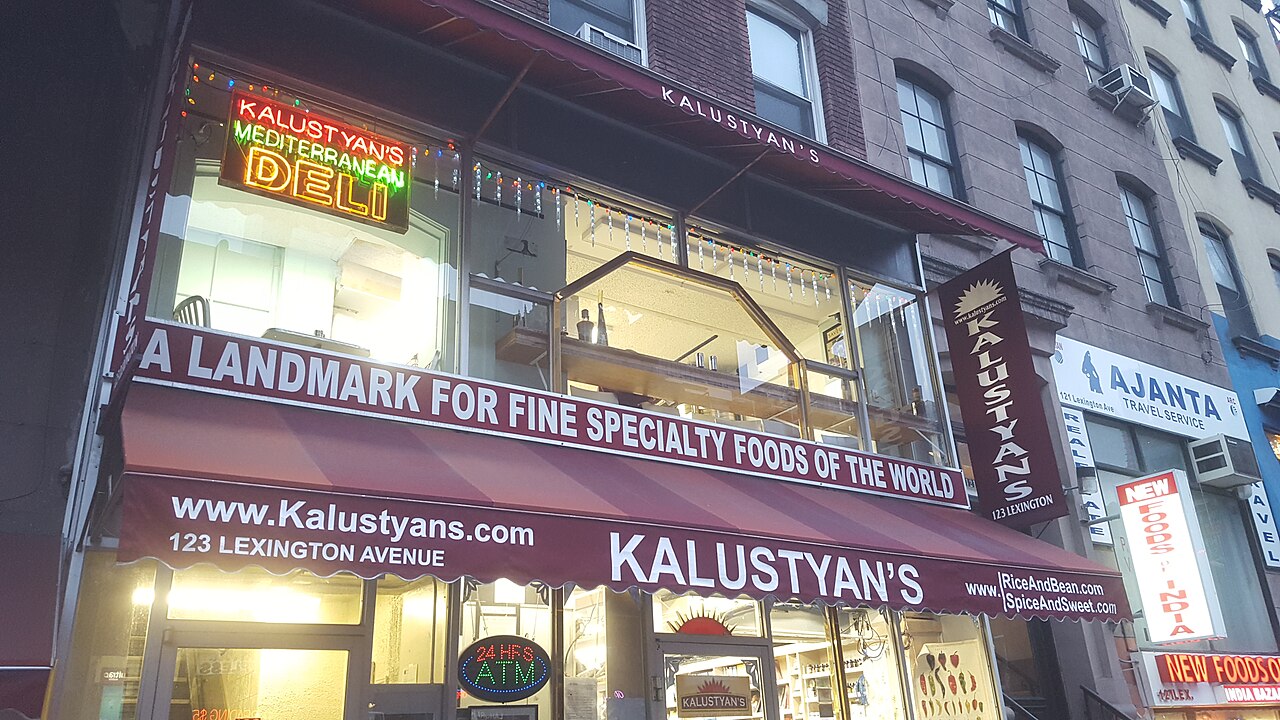
The anchor is Kalustyan’s at 123 Lexington Avenue, which has been open since 1944. It stocks over 2,500 specialty food items and ships globally. Thomas Keller, Daniel Boulud, and other celebrated chefs have been regulars. The store opened when Murray Hill was still a patrician neighborhood of old-money families and restrictive covenants. That it survived and thrived through every demographic shift since is one of the better stories in New York food history.
The Curry Hill cooking culture matters for cleaning because the kitchens in this corridor get used seriously. Turmeric, cumin, frying oil, and spice pastes leave residue on range hoods, backsplashes, cabinet faces, and the ceiling above the stove that a surface wipe will never touch. We degrease every kitchen surface within six feet of the stove, pull the drip trays, and clean the exterior of the hood where that film settles. A deep clean handles the oven interior if you need it.
Prewar co-ops along Park Avenue need cleaners who understand what the walls are made of
The residential core of Murray Hill is the avenue buildings. Park Avenue between 34th and 40th Streets is lined with 12 to 16 story apartment buildings from the 1920s and 1930s, built in Beaux-Arts and early Art Deco styles. These are substantial prewar co-ops with thick plaster walls, high ceilings, hardwood floors, crown molding, and the kind of interior construction that newer buildings do not replicate.

Cleaning these apartments means understanding what the surfaces are. Plaster walls stain permanently if you apply moisture to an unsealed area. Crown molding from the 1920s chips if you scrub it. Original hardwood floors have been refinished multiple times over the decades, and the remaining finish is thinner than it was originally, which means it reacts to harsh chemicals more aggressively. We use dry microfiber on the plaster, pH-neutral solutions on the hardwood, and we note every building’s specific finishes on the first visit.
The postwar rentals on Third and Second Avenues are a different story. These are utilitarian buildings from the 1960s through the 1980s, built for volume. The apartments are smaller, the surfaces are more forgiving, and the cleaning is more straightforward. A standard recurring apartment cleaning handles most units in under two hours.
The historic district brownstones on 36th and 37th Streets are the most architecturally sensitive cleaning jobs in the neighborhood. Greek Revival rowhouses from the 1840s. Italianate brownstones from the 1860s. Queen Anne townhouses from the 1880s. These homes have original millwork, decorative plaster, marble mantels, and tile fireplace surrounds that nobody installs anymore. We send experienced teams to these addresses and we allow extra time. The surfaces are irreplaceable and we treat them that way.
Murray Hill apartment cleaning works around a Midtown professional schedule
Most Murray Hill residents work within walking distance of their apartment. Grand Central Terminal is a ten-minute walk from anywhere in the neighborhood. The 4, 5, and 6 trains run every few minutes during peak hours. The 7 train connects to Queens at Grand Central. The S shuttle gets you to Times Square in two minutes. This is one of the most transit-connected residential neighborhoods in the city, and the people who live here chose it for exactly that reason.
That Midtown proximity shapes how cleaning works. The majority of our Murray Hill clients are not home during their cleaning. They leave a key with the doorman, set up a lockbox, or coordinate directly with building management. The cleaning happens during the workday and the apartment is ready when they walk in. For the prewar co-ops that require advance vendor notice and a Certificate of Insurance, we handle the paperwork before the first visit. For the doorman buildings, we check in at the front desk and take the service elevator. For the side-street brownstones with no doorman, we use whatever access method the client provides.
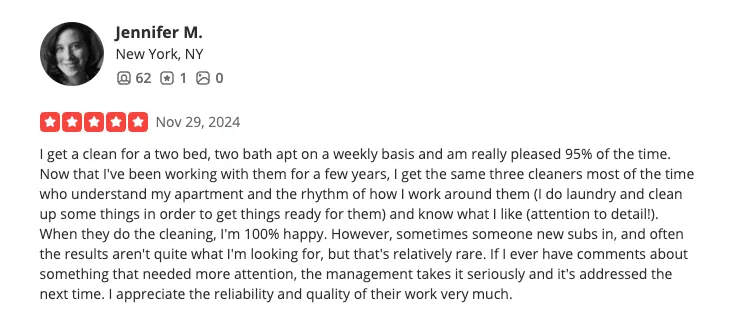
Recurring apartment cleaning on a weekly or biweekly schedule is the most common booking in Murray Hill. The apartments are well-maintained, the residents are busy, and the goal is to keep the space consistently clean without the client having to think about it. For a first-time reset, particularly in an older apartment where dust has settled into radiator fins and grime has built up on kitchen surfaces over months, a deep clean does the heavy lifting so that recurring visits can maintain it.
For tenants moving in or out, our move-in and move-out cleaning covers inside cabinets, appliance interiors, baseboards, window sills and ledges, and every surface a landlord or management company will inspect. Murray Hill’s rental stock turns over frequently, especially in the postwar buildings on Second and Third Avenues, and we handle these regularly.
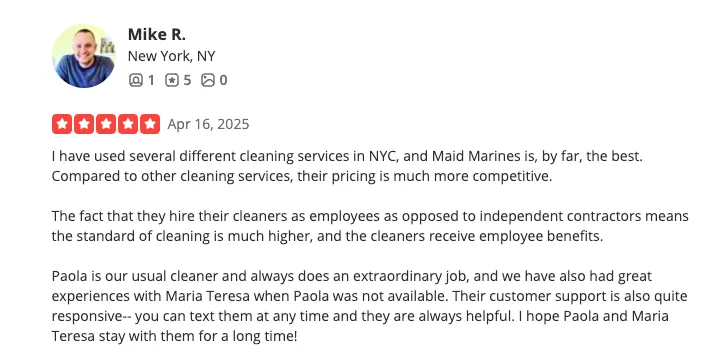
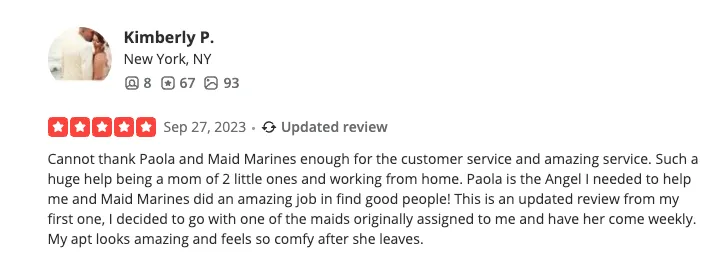
You pick your date and time on our booking page. You see your flat-rate price before you commit. Our cleaners are W-2 employees, not gig workers. They are vetted, insured, and they show up with the right products for your specific building. We serve Murray Hill and all of Midtown Manhattan, including nearby Kips Bay, Rose Hill, Tudor City, Midtown, and Gramercy Park. Browse our full list of cleaning services or check our house cleaning and apartment cleaning pages for details on what each visit includes.