
The name Boerum Hill was invented in 1964. Before Helen Buckler of the Boerum Hill Association coined it, the neighborhood was called North Gowanus, after the industrial canal at its southeastern edge. Buckler chose a colonial Dutch surname to give the blocks a more prestigious identity and attract investment to the brownstones that were, at the time, being subdivided into rooming houses and running to ruin. The strategy worked. Boerum Hill became one of the most recognized and coveted neighborhood names in Brooklyn, and the brownstones that Buckler was trying to protect are now worth two to four million dollars apiece.
The physical neighborhood those brownstones occupy is a compact, nearly flat patch of central Brooklyn bounded by Schermerhorn Street to the north, Fourth Avenue to the east, Wyckoff Street to the south, and Court Street to the west. Roughly 0.3 square miles. Twelve thousand residents. Almost entirely built out in a single thirty-year window between 1840 and 1870, which is why the streetscape on Dean Street or Bergen Street feels unusually coherent: the buildings are the same age, the same material, the same proportions, built for the same class of artisan and tradesman who needed housing within walking distance of Brooklyn’s waterfront shipyards.

Cleaning brownstones built in 1860 requires different products than cleaning anything built since
The defining building in Boerum Hill is the three-story attached brick rowhouse. Most were constructed between 1845 and 1870 in Greek Revival and Italianate styles. Most have been renovated, expanded, and subdivided multiple times since then. The cleaning challenges that result are specific in ways that a generic service will get wrong.
Parlor floors run 10 to 12 feet at the ceiling. Original wide-plank hardwood floors in these buildings are old-growth and extremely dense, but they are typically finished with wax rather than polyurethane, which means water will penetrate and raise the grain. Decorative plaster crown molding, present on nearly every parlor and second-floor room in the historic district, requires a soft brush and dry microfiber, not a damp cloth. Original cast-iron railings on stoops and interior stairs collect grime in their recesses that a surface wipe will not touch. Marble mantels, present in most original-condition rowhouses, etch immediately with anything acidic.
Our house cleaning teams carry separate products for each surface type and switch between them as they move through the building. Hardwood gets a barely damp microfiber with a wax-compatible cleaner. Plaster gets dry methods. Marble gets a pH-neutral wipe and nothing else. We clean top to bottom on every floor so dust dislodged from 12-foot crown molding never settles onto surfaces already cleaned below. These buildings have survived since the Lincoln administration. The goal is to keep them that way.
Pre-war walk-up apartment buildings scattered throughout the neighborhood present a different but related set of considerations. These brick buildings from the 1890s through the 1940s have nine and ten-foot ceilings, herringbone parquet floors in the better units, and deep-set windows with marble or brownstone sills that collect grime in their lower corners. The apartments are typically larger and better-proportioned than anything built after 1945, but they require the same surface-specific attention as the rowhouses.
New-construction condos along Atlantic Avenue and Fourth Avenue are straightforward by comparison. Engineered hardwood, tile, and standard finishes that tolerate standard products. The challenge with these buildings is logistics: most require advance vendor registration, some require a Certificate of Insurance naming the building as additional insured, and service elevator access needs coordination with the front desk. We handle all of that before your first appointment so the morning of your cleaning does not begin with your cleaner standing in the lobby waiting for a super who was not notified.
Your cleaning runs two to three hours and Boerum Hill gives you excellent options for that window
Smith Street runs the full length of the neighborhood from Atlantic Avenue south through Bergen and Dean. It became a restaurant row in the late 1990s, and while it has evolved considerably since then, it remains one of the better-stocked streets for a walk in Brooklyn. Bien Cuit at 120 Smith Street does handcrafted loaves and croissants that rank among the best in the city. The transit connection from Bergen Street is fast enough that the Transit Museum on Schermerhorn is reachable in minutes.
Atlantic Avenue, along the northern edge, carries a different and older energy. Sahadi’s at 187 Atlantic has been there since 1948, decades before the neighborhood had its current name, and remains one of the best specialty food stores in New York. Damascus Bread and Pastry at 195 Atlantic sells Lebanese pita and Syrian pastries from one of the last businesses on the block still connected to Atlantic Avenue’s Arab-American past. The Invisible Dog Art Center at 51 Bergen Street hosts thirty-plus artist studios in a converted 1863 factory and opens to the public for exhibitions and events.

A proper deep clean in a multi-floor Boerum Hill brownstone is not a two-hour job
A deep cleaning in a three-story rowhouse on Pacific Street means working through a building that accumulates dust differently at each level. Steam heat radiators on every floor collect dust between their fins all summer and burn it off when heat starts in October. Crown molding at 12 feet gathers grime through the year. The garden level, if there is one, often has a different floor material entirely from the upper floors. Kitchen exhaust from a household that cooks collects grease on the range hood and on cabinet fronts above the stove. Bathrooms in these buildings frequently have original hex tile with grout lines that narrow at the edges and require attention.
We price deep cleans based on bedrooms, bathrooms, and square footage. A three-story Boerum Hill brownstone is priced differently from a one-bedroom apartment, and the price reflects real time and real labor. You will see the exact number on the booking page before you commit to anything.
Move-in and move-out cleaning is one of the most common requests in this neighborhood. Boerum Hill has a competitive rental market where floor-throughs in brownstone conversions change tenants regularly and where landlords and tenants both expect a thorough clean between occupancies. The scope goes deeper than a standard recurring clean: inside appliances, inside cabinets, baseboards, window tracks, and the kind of accumulated grime in corner spaces that a surface clean bypasses entirely.
Recurring apartment cleaning for a neighborhood that is at home most of the week
Boerum Hill has a notably high concentration of people who work from home or on flexible schedules. The neighborhood’s median age is around 35, the residents skew heavily toward creative and professional fields, and the brownstone blocks are quiet on Tuesday afternoons in ways that most New York neighborhoods are not. A significant portion of our Boerum Hill clients are home during their cleaning appointment.
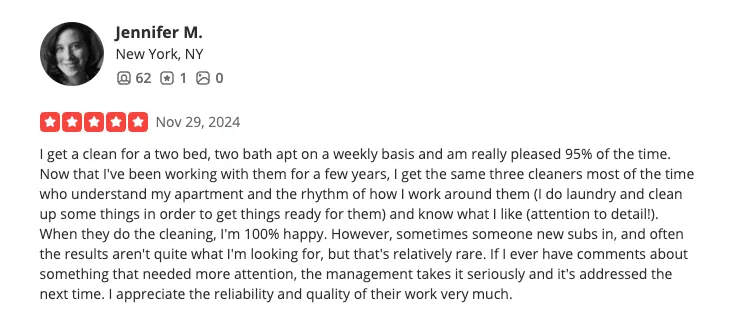
We clean around working households without disruption. The standard approach is to start at the top of the building or in rooms farthest from the home office and work toward it. Noisier tasks like vacuuming get sequenced around any standing calls you have. Some clients prefer we skip their office entirely during the appointment and return to it at the end. We also assign the same team to your home for every recurring visit. Consistency is not just a logistics preference: in a neighborhood with this many dogs and this many owners who keep specific schedules, having the same cleaner who already knows where everything is and which dog is nervous around strangers matters for both the cleaning quality and the household’s functioning.
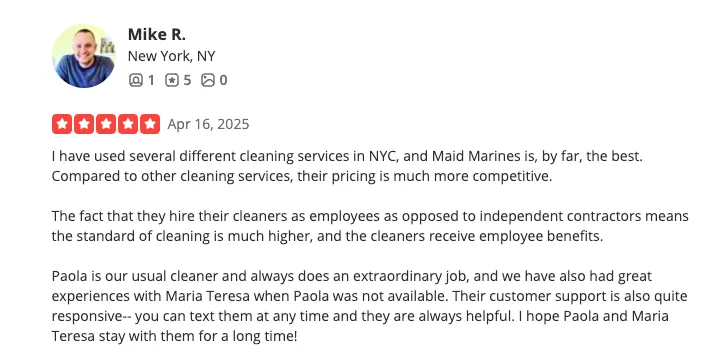
Our cleaners are W-2 employees, not independent contractors. That matters for the level of training and consistency you can expect on every visit, and it matters for the insurance coverage that applies if anything goes wrong. For buildings that require vendor documentation, we furnish Certificates of Insurance and coordinate with management before the first appointment. For recurring apartment cleaning in a building where the doorman needs to know who to expect, we provide team names in advance.
What booking looks like from here
You pick a date and time on our booking page and see your exact flat-rate price before you commit. If your brownstone has three floors plus a garden level, the price reflects that. If your new-construction condo building needs paperwork on file, you tell us once and we handle it. We have cleaned over 100,000 homes across New York City and the details of the booking process are not complicated.
We also serve nearby Park Slope, Bed-Stuy, DUMBO, and Greenpoint.